The Bad British Architecture blog has slightly different aims to Ugliness blog.
There are some astoundingly poor designs highlighted on this site, that quite frankly, wouldn't qualify them
for this blog. Here, we need to at least admire the ugliness of a building before it features, and indeed many ugly buildings have merits beyond their unfortunate genes.
However, if you want to see just how bad things can get have a peek at:
http://badbritisharchitecture.blogspot.com/
These buildings were designed by architects with seven years training. We cannot blame everything on design and build contracts.
Showing posts with label architecture. Show all posts
Showing posts with label architecture. Show all posts
Monday, 14 June 2010

Monday, 10 May 2010
Ugly Architecture on Flickr

Well I never, a group on Flickr devoted to my favorite topic!
There are some real gems here such as Boston City Hall: (photo by joe shlabotnik)
There are others that are photographed in a too 'arty' manner. If it is an ugly building don't try to make it look better through choreographed photography.
Ugly buildings can still make great architecture
The incomplete, unfinished, and unkempt can still make good architecture. An unresolved ambiguous composition [i.e. post-structuralist] is often more satisfying than the finished and complete [i.e. structuralist]
Perhaps as we engage with the 'death of the author', and begin to acknowledge the presence of the 'reader' we create space for 'un-complete' and fragmented solutions.
The World's Ugliest Buildings?
Come on Guardian, you must be able to do better than that!
The Guardian lists the following as being the World's Ugliest Buildings:
1. House of the Republic (now Palace of the Parliament), Bucharest
Nicolae Ceaucescu's monumental folly still holds world records for the largest civilian administrative building, most expensive administrative building, and heaviest building in the world. Constructing it required demolishing much of Bucharest's historic district, including 19 Orthodox Christian churches, six Jewish synagogues, three Protestant churches, and 30,000 residences. It's still unfinished.
2. Buckingham Palace, London
Home to the second-longest lasting unelected head of state in the world, let's face it, it's monolithic and could have been built by Stalin. Nash no doubt did his best to beautify a pig, but a pig it remains.
3. Ryerson University Library, Toronto
Proving that democracy can also be brutal (just ask the Iraqis), this 11-storey tower looks more like a second world war fortification than a temple of learning. The sort of place you wouldn't want to be late returning books to.
4. Any McDonald's drive-thru, anywhere
They are to architecture what the Happy Meal is to nutrition. And they're always the same. Everywhere. Around the world. No matter where they've plonked them. Vernacular? What's that?
5. St George Wharf, London
Butterflied prawns are good, butterflied roofs are not. What were they thinking? Occasionally voted the UK's most hated building, it probably wouldn't look out of place in Shanghai.
Sunday, 9 May 2010
Spending a Penny: The Humble Public Convenience
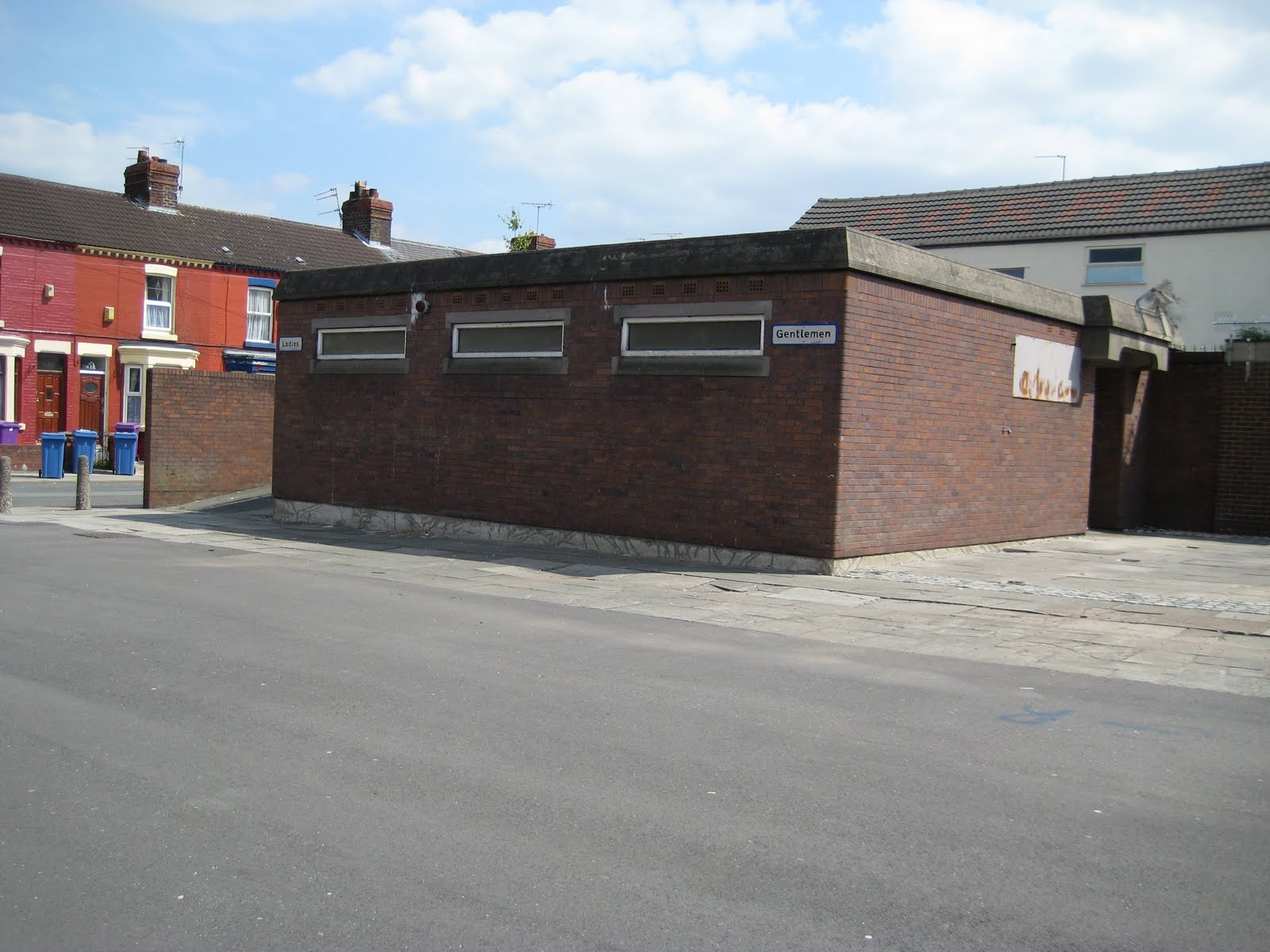
Unlike the current trend for prefabricated WC's that we find in our city centres of late, previous versions were far more substantial and determined.
Here we see a squat brick structure with high level openings and flat roof.
The structure is split into two rooms; one for male customers, the other for female.
Although now synonymous with the popular trend for 'cottaging', they represent a caring civic attitude and concern for the welfare of visitors to the city.
Whilst there is a stark functionalist aesthetic to the structure, other functions such as hygiene, beauty and safety are sadly neglected. There is a meanness to the architecture, its defensive form and materials attempting to withstand abuse and vandalism.
Saturday, 8 May 2010
The Death of Modernism


Here we see La Princesse [a giant mechanical spider, see http://www.lamachine.co.uk/] descending down the side of Concourse House in Liverpool.
Located on a key site next to Lime Street Station the building represented post-war optimism through its high-rise, high specification and city views.
In reality it was ill-located, poorly maintained and perhaps represents the worst of modernist design through its monotonous facade and lack of concern for how the building touched the ground plane.
The spider's bite sealed the buildings fate and it has now been demolished.
What will take its place? The land value of this site must be considerable and rental incomes could be significant....
Sunday, 3 January 2010
Cemetery
 The Cemetery
Within our cities and towns we set aside designated places for the burial of our dead. The photographs on this blog are taken from Smithdown Road Cemetery, Liverpool. A quick look at the Ordnance Survey Maps of Liverpool reveals that the cemetery was located well away from the city when it was first built - presumably to ensure that disease was kept well away from the inhabitants. Eventually the city engulfed the cemetery and a Workhouse [designed by Culshaw & Sumners] was built next door to the grave yard - presumably because land was cheap and it reduced the travel distance: in one door - out the other.
Today, despite the drunkards and the Staffordshire bull terriers it is a delightful setting. Its ugliness comes through the ostentatious vanity of some of its occupants. The futile attempts at immortality and claiming importance in death as in life, or perhaps I'm mistaken, and the extravagant commemorations are displays from loved ones. We see a  variety of styles, miniature gothick Albert Memorials, peculiar cenotaphs with sculpture & bas relief and the inevitable urns. A collection of obelisks creates an interesting display, some with vastly over-scaled pedestals reducing the obelisk to a mere finial.
 variety of styles, miniature gothick Albert Memorials, peculiar cenotaphs with sculpture & bas relief and the inevitable urns. A collection of obelisks creates an interesting display, some with vastly over-scaled pedestals reducing the obelisk to a mere finial.
Subscribe to:
Posts (Atom)


